Monday, March 14, 2016

Frank Hursh: Painting backgrounds for Rocky & Bullwinkle in Mexico, Part 1


Frank Hursh, head of the background dept. at Gamma Productions
During the writing process on The Art of Jay Ward Productions, I put out an all points bulletin on the Internet looking for a few artists who had either worked directly for Jay Ward in Hollywood or for Val-Mar/Gamma Productions in Mexico, the subcontractor for all animation production on the Jay Ward series.  One of those artists was Frank Hursh, an American painter who had headed up the background department at the Mexican studio in the early 1960s, a crucial period in the history of the Ward studio.

Admittedly, my request was a long shot and I had low expectations for any kind of response.  However, while the book was at the printer’s, I received a phone call from Frank’s daughter, Holly, responding to my posting which she had just discovered while searching on the Internet.  She was calling from Mexico with her father standing right next to her.  While it was too late to include any new information or art from Frank, it wasn’t too late for me to ask questions or to find out that his memoirs had been published in a bilingual book in Mexico.  Later I found out that Frank had photos of the personnel and studio from it's heyday along with a few pieces of original art.  It's unlikely there will be a second edition of The Art of Jay Ward Productions so I've decided to highlight Frank Hursh and his time at the Gamma studio with a multi-part blog post.

One of Frank's backgrounds from the Bumbling Brothers Circus adventure
The most obvious question for me was 'how did an American fine arts painter end up in Mexico working on Rocky and Bullwinkle?'  Here, in Frank's own words, is his story:

I had come to Mexico with two scholarships to study a Master´s Degree in Mural Painting at the Mexico City College (now Universidad de las Américas) and San Carlos, the art school of the National University (Universidad Nacional Autónoma de México). I also started doing some television production and television art, and had become a partner in a company called Telepelículas. I had fallen in love with Mexico, so colorful and vibrant, and soon I left school to work full time. 

The population of Mexico City was only about 3 million at that time (middle 1950´s). There was not much traffic. There were no stoplights along Paseo de la Reforma, which was such a beautiful boulevard. There were glorietas (roundabouts) and there was a tacit understanding of how traffic was to flow around those. I never saw a car accident along that street. You could walk any place in Mexico City without ever being bothered. It was such a lovely city– everybody seemed to know each other. We did a lot of partying, getting together often to have a drink and some tacos, going to Xochimilco for a ride on the chinampas (flat boats) and lots of mariachi music. We had a good time. 

I had met Bud Gourley before, the Operating Administrator in the animation studio (Val-Mar) at that time, and I told him that I was looking for a job.  He asked me if I had had any experience in animation, which I hadn't, so I didn't get the job.  Sometime later, after my wife and I had separated, I rented my house to Harvey Siegel (a veteran of the NY animation industry sent to assist with production), who invited me over to a get-together that he was having with some people from the (Ward) studio in the States. I had painted a picture of a train for my children´s bedroom, and Bill Hurtz (one of Ward's directors) saw it. He said to me “Frank, I don´t have anybody down here to do color. Can you come and give us a hand?” So that´s how I got into animation.

The painting that got Frank Hursh his first job as an animation background painter.
At Gamma, there were 250 – 300 people working at any one time. I had from 8 to 12 people, depending, in my Department.  Guillermo Aguilar was my assistant.  All in all, we did some 18 and a half minutes of limited animation a week. At 12 images per second, that’s about 13,320 images produced in a week! That means layout, backgrounds, inking and painting, photographing! We did quite a lot of work, very quickly. 

Some of Frank's BG crew: L to R, Nacho Brambilla, Tio, unknown, Mau Mau Arellano, Sergio, Raul Vilchis, Faufis
Sometimes, we did get some crazy things out of layout that changed the style of the backgrounds [that had already been done] for the whole show—and we would be so busy trying to match things up for the animation. One time we got a layout that was completely different from all the others and we had no time to change it. It was a bit crazy. Sometimes, because of rushing around, things were not done in the same style, which was visibly noticeable when it was aired. It gave the show a quirky feel, a bit off the wall. I think that was one of the things, along with the dialogue, that helped the appeal of Rocky & Bullwinkle.  

Next week, more rare photos and art, along with part 2 of Frank's life at the Gamma studio in Mexico City.

Thursday, December 17, 2015

A Jay Ward Christmas

Jay Ward and Bill Scott sent out unusual Christmas cards and gifts to employees, freelancers and clients (see last year's post here) but perhaps the most unusual Christmas gift they ever gave was to director Ted Parmelee to commemorate his contributions to the success of the first year of Rocky and His Friends.  Since Bullwinkle the moose figured prominently in the series, the duo had delivered to Parmelee's home a full-sized stuffed moose head. 


Parmelee responded by bombarding Ward and Scott with a series of over a dozen gag cartoons riffing on the gift.  The above cartoon was included in The Art of Jay Ward Productions but space and content considerations prohibited including any more.  So, because the moose head was a Christmas present and we're in the Christmas season, here are many of those cartoons revealing not only Parmelee's sense of humor about his gift but also his confident, calligraphic drawing style.  Incidentally, the stuffed head hung in the Parmelee household for years afterwards.

 
The moose head was driven through Hollywood in a small sports car on it's way to Ted Parmelee's house.
One of Ted's passions was sailing.


Tuesday, December 8, 2015

The real origin of Dudley Do-right


Model sheet by director Pete Burness

If you've read either Keith Scott's The Moose That Roared or my book, The Art of Jay Ward Productions, you know that the Dudley Do-right we're all familiar with didn't spring fully formed on The Bullwinkle Show but had his origins in 1948 when Jay Ward and Alex Anderson teamed up to produce the first nationally broadcast animated television series, Crusader Rabbit.  Crusader was only one of three proposed series, the other two being Hamhock Jones, a Sherlock Holmes parody, and Dudley Doright of the Mounties, a parody of  the Nelson Eddy/Jeanette McDonald filmed operetta, Rose-Marie, and classic melodramas.  Hamhock was destined to be a footnote in animation history but Jay Ward revived Dudley 13 years later with a tremendous assist from designer Al Shean and writers Chris Hayward and Lloyd Turner.

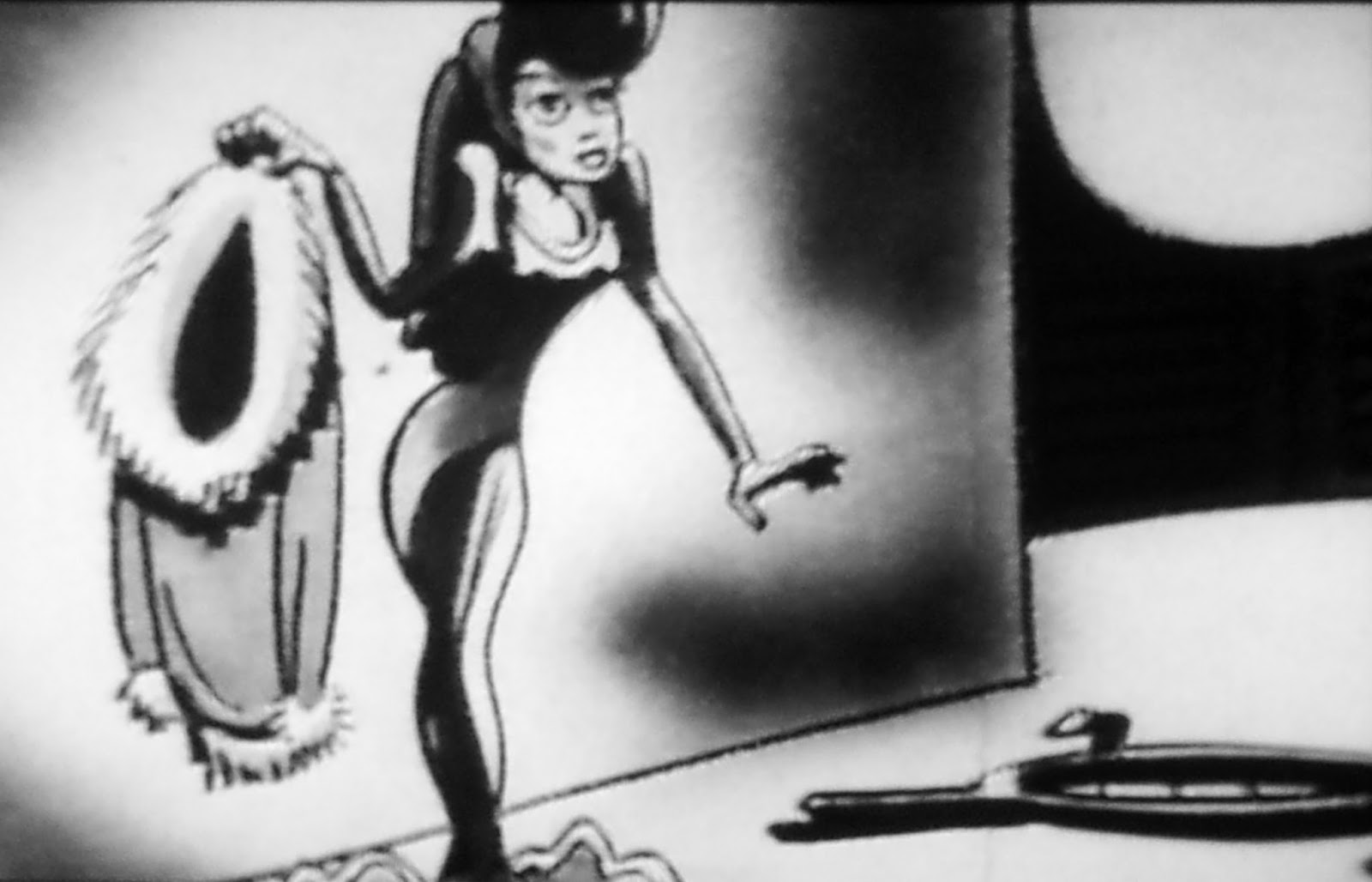
Ward and Anderson produced pilots for all three series, which consisted of Alex Anderson's drawings "animated" with camera movement on the still artwork and using a much slower narrator (Crusader Rabbit's Roy Whaley) than the later series.  The basic formula was established with the stereotypical melodramatic villain, here known as Sydney "The Snake" Snodgrass, the sweet heroine, Bess Blushmore, and the hero, Dudley Doright, a member of the Royal Canadian Mounted Police.  Only Dudley retained his name, the other two became Snidely Whiplash and Nell Fenwick.  The pilot was set in Deepfreeze Landing and the story unfolded in rhyme, as if from Robert W. Service's classic poem, "The Shooting of Dan McGrew."  Here, a very rare peak at some images from the lost Dudley Doright pilot:

That beer drinking, pistol shooting bad guy, Sydney "The Snake" Snodgrass.


The demure Bess Blushmore, patterned after Preston Blair's Red Hot Riding Hood.

No good can come of this; Sydney introduces himself to Bess.

Dudley Doright on the lookout for bad guys.

Somehow, a slide whistle figures into the plot.

Dudley Doright of the Mounties to the rescue.

Inspector Fenwick was never part of the original concept.


The pilot was produced as a cliffhanger, leaving the ending up to potential sponsors of the show.  The real outcome wouldn't be revealed for 13 years, when Dudley ended up with his own series on 1961's The Bullwinkle Show, replacing Peabody's Improbable History. 


Neither was Dudley's horse, Horse.


Chris Hayward and Lloyd Turner took Anderson's concept over the top, turning it from an adventure series into a parody of an adventure series while Jay Ward's ace designer, Al Shean, re-imagined the characters in his own inimitable style.


These last three model sheets by Al Shean.


To read more about Dudley's origin and how it came to be one of the best of all of Ward's shows, check out The Moose That Roared and/or The Art of Jay Ward Productions.  The latter can be purchased for half off Amazon's list price at artofjayward.com.