Showing posts with label Dudley Do-right. Show all posts

Tuesday, December 8, 2015

The real origin of Dudley Do-right


Model sheet by director Pete Burness

If you've read either Keith Scott's The Moose That Roared or my book, The Art of Jay Ward Productions, you know that the Dudley Do-right we're all familiar with didn't spring fully formed on The Bullwinkle Show but had his origins in 1948 when Jay Ward and Alex Anderson teamed up to produce the first nationally broadcast animated television series, Crusader RabbitCrusader was only one of three proposed series, the other two being Hamhock Jones, a Sherlock Holmes parody, and Dudley Doright of the Mounties, a parody of  the Nelson Eddy/Jeanette McDonald filmed operetta, Rose-Marie, and classic melodramas.  Hamhock was destined to be a footnote in animation history but Jay Ward revived Dudley 13 years later with a tremendous assist from designer Al Shean and writers Chris Hayward and Lloyd Turner.

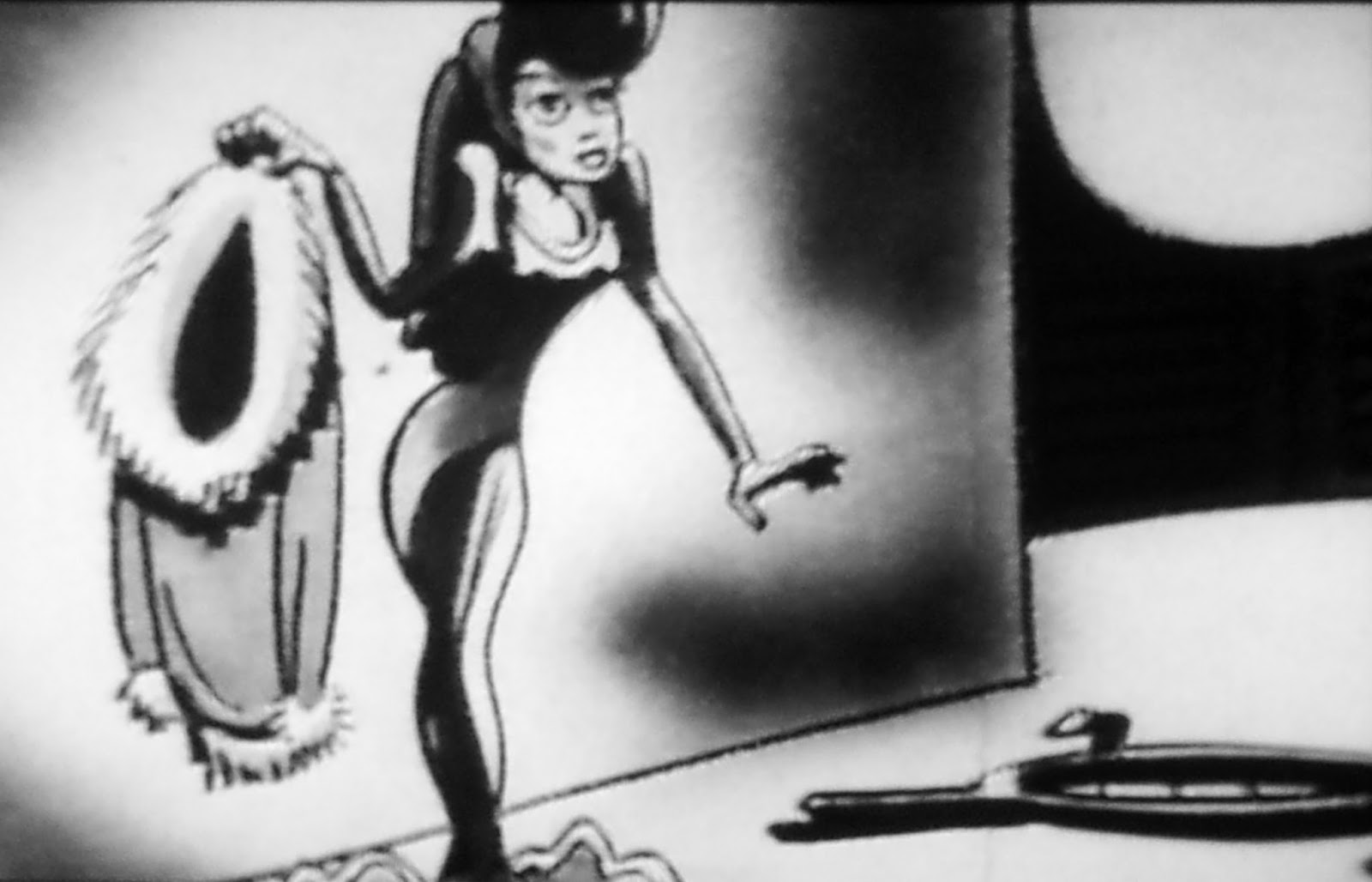
Ward and Anderson produced pilots for all three series, which consisted of Alex Anderson's drawings "animated" with camera movement on the still artwork and using a much slower narrator (Crusader Rabbit's Roy Whaley) than the later series.  The basic formula was established with the stereotypical melodramatic villain, here known as Sydney "The Snake" Snodgrass, the sweet heroine, Bess Blushmore, and the hero, Dudley Doright, a member of the Royal Canadian Mounted Police.  Only Dudley retained his name, the other two became Snidely Whiplash and Nell Fenwick.  The pilot was set in Deepfreeze Landing and the story unfolded in rhyme, as if from Robert W. Service's classic poem, "The Shooting of Dan McGrew."  Here, a very rare peak at some images from the lost Dudley Doright pilot:

That beer drinking, pistol shooting bad guy, Sydney "The Snake" Snodgrass.


The demure Bess Blushmore, patterned after Preston Blair's Red Hot Riding Hood.

No good can come of this; Sydney introduces himself to Bess.

Dudley Doright on the lookout for bad guys.

Somehow, a slide whistle figures into the plot.

Dudley Doright of the Mounties to the rescue.

Inspector Fenwick was never part of the original concept.


The pilot was produced as a cliffhanger, leaving the ending up to potential sponsors of the show.  The real outcome wouldn't be revealed for 13 years, when Dudley ended up with his own series on 1961's The Bullwinkle Show, replacing Peabody's Improbable History


Neither was Dudley's horse, Horse.


Chris Hayward and Lloyd Turner took Anderson's concept over the top, turning it from an adventure series into a parody of an adventure series while Jay Ward's ace designer, Al Shean, re-imagined the characters in his own inimitable style.


These last three model sheets by Al Shean.


To read more about Dudley's origin and how it came to be one of the best of all of Ward's shows, check out The Moose That Roared and/or The Art of Jay Ward Productions.  The latter can be purchased for half off Amazon's list price at artofjayward.com.

Monday, August 24, 2015

Gerard Baldwin and the art of TV animation


Readers of either of my books, The Art of Jay Ward Productions or Mr. Magoo's Christmas Carol, The Making of the First Animated Christmas Special will instantly recognize the name Gerard Baldwin.  Working for Jay Ward, he directed and animated many of the best episodes of Fractured Fairy Tales, Aesop & Son and Dudley Do-right at Jay Ward as well as animating several pilots such as Hoppity Hooper, Super Chicken and George of the Jungle.  Baldwin was also responsible for directing and animating the highly memorable, show-stopping sequence featuring the Despicables in Christmas Carol.  Baldwin had a flair for turning the limitations of low-budget animation into assets while squeezing out the highest possible entertainment value.


Now, you can learn a little bit more about the master himself in his new book, From Mister Magoo to Papa Smurf, A Memoir by Gerard Baldwin, available at Amazon and Barnes & Noble.  Beginning at his beginning, Baldwin recounts growing up in New York, his decision to become an artist and his sideways move into the medium that would define his career, animation.  You'll read about his early days as an inbetweener at UPA, his military service, his return to UPA and his rise as an animator and director in the TV animation industry, culminating in becoming a producer on Hanna-Barbera's The Smurfs.  Between his stories from the animation trenches and his wry observations, there are a number of charming drawings illustrating anecdotes from his life.


During it's baby boomer heyday, television animation was usually looked down upon, especially by those in the industry.  Consequently, very few animators and directors from that era put their experiences and thoughts down on paper; this is rare insight into the art and commerce of 1960s animated cartoons that is of interest to not only those that grew up with the cartoons but for anyone who follows pop culture.  You can buy it here.

Monday, April 13, 2015

Sam Clayberger and Dudley Do-right

Probably the most consistently funny series of all Jay Ward's productions, Dudley Do-right of the Mounties had a handful of its episodes produced in Hollywood, most of them directed and animated by Gerard Baldwin.  Sam Clayberger remembered painting a lot of RCMP forts but as you can see by the images below, he painted much more than that.  This first batch of images is from the first Dudley episode, Disloyal Canadians.  The first and fifth images are the color keys for the backgrounds reproduced on page 186 of The Art Of Jay Ward Productions.


You can see the video for Disloyal Canadians here.  Notice how the color is unlike any of the keys above. 

Next,Foreclosing Mortgages:


Color keys for Mechanical Dudley, the background for this first image is reproduced on page 188 in The Art of Jay Ward Productions:


Saw Mill:


Next week, some more color keys for Rocky & Bullwinkle, Mr. Peabody and Sherman and more!